


INDEPENDENT TEST ORGANIZATION TEST RESULTS
The following graph summarizes the stopping distance performance for the 4 sets of tyres 205/55 R16 and 3 sets of tyres 225/45 R17.
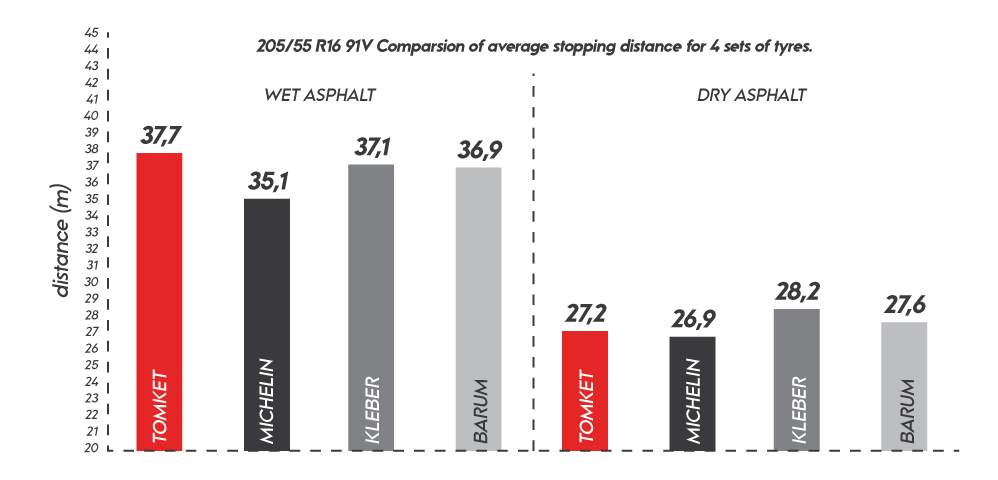
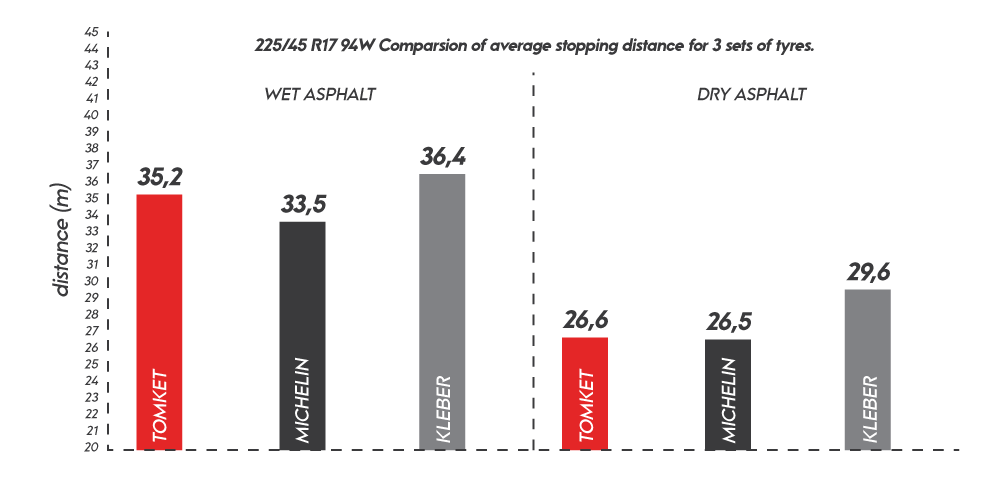
Dry asphalt stopping distance: 100 to 0 km/h. Wet asphalt stopping distance: 80 to 0 km/h

Straight line driving
Driving in a straight line at different speeds, the steering response, feeling and steering efforts are evaluated by doing small and gentle steering inputs.
Steering performance (cornering)
Trajectory tracing, response at off-centre, steering precision, linearity, steering effort and front-rear grip balance are evaluated during cornering manoeuvres.
Active safety (stability)
The dynamic response of the vehicle is evaluated when performing lane change manoeuvres ranging from very low lateral acceleration up to the grip limit. Body roll, braking in a turn, power-off reaction and grip limit level are evaluated as well.
Ride comfort
Acoustic comfort and vibrations are evaluated.
Wet handling
Front-rear Balance, Traction capacity, rear axle stability, power-off reaction and controllability at the linit in wet conditions are evaluated. The table below serves as a guide for the interpretation of the evaluation ratings:

The overall ratings of the subjective evaluation are shown in the following table:
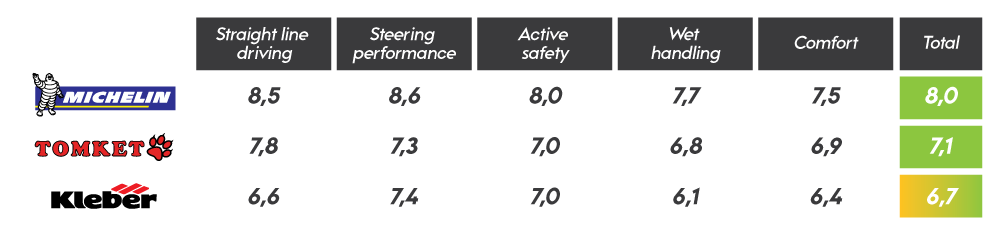
Michelin Primacy 3 tyre set has had a good overall performance. This tyre is a reference on wet and dry conditions, with still a good comfort level. This tyre set is considered a really good tyre for this car’s segment. On straight line driving, the feedback transmitted to the driver is very high and has an excellent modulation for small steer angles. The steering performance is marked by a good overall precision, with almost no delays and hysteresis and the stability performance is marked by a good roll and yaw dampings.
Tomket Sport 3 tyre set shows also a good straight line driving performance and a steering performance but with slight front and rear axle delays. Active safety is marked by a lack of roll control, with larger roll angles , making it more difficult to control in some situation than the competitors. On wet surface even with lower overall performances than Michelin still has a good level of grip, with enough front axle response and enough rear axle grip. The comfort level is good, but too much of shake is transmitted into the cabin.
Kleber Dinaxer HP3 tyre set hasn’t scored as high as the other tyre sets, marked by a lack of grip on wet surface which generates a lack of confidence in these conditions. Also in comfort area has scored too low due to a bad surface rear right tyre, transmitting into the cabin a lot of vibrations. This tyre set is clearly the noisiest of the test.
TOMKET SPORT 3
Wet handling
This tyre shows less grip potential than the reference tyre, but is still at a good level. Front axle is not so responsive for aggressive inputs, generating higher amounts of understeer than the reference tyre. The balance is more towards understeer, due to a lower grip level. The rear axle stability is good, but needs a lot of time to recover. At the limit larger countersteer is needed. The traction capacities, even with less grip still good on wet conditions.
Straight line driving
This tyre provides lower front axle response than variant Michelin and two-times feel was perceived. Some corrections are needed to keep the straight line but this isn’t a concern. Less precise for small steer angles. There’s a slight lack of centre definition, but almost no elastic feel. Still good on this area.
Steering performance
This tyre shows a delay on the front axle and a small delay on the rear axle but still good response. The precision is good, but we found it difficult to modulate trajectory for small lateral accelerations. The steering feedback is lower than with reference tyre, but still at good level. This tyre set needs larger angles needed than Michelin for the same corner, generating less lateral acceleration.
Active safety
This tyre set has good performance on this area, clearly lower than reference but still good. The balance is more neutral than Michelin due to a lower grip level. The balance is set towards understeer, but some oversteer can occur with aggressive inputs or weight transfers. If this happens, oversteer rate is slow but also grip recovery is very slow, due to a lack of grip on the rear. Nevertheless, it is predictable and easy to control at the limit with larger countersteer angles. For high lateral acceleration manoeuvres the roll angles are quite high and some lack or roll damping was felt.
Comfort
The amount of bobbing, even at low speeds is increased and there’s a slightly sharper feel on smaller and bigger impacts, but they remain rounded, still good. Impact forces are good and the filtration of harshness is at lower level than Michelin, but still good performance on comfort area. The rolling noise is slightly lower at low speed than Michelin, but slightly higher at high speed.